

Best Freestyle & Park Snowboards for Winter 2026/2027
From rails and side hits to big jumps, our pick of the



Inside 50 years of Burton with archivist Todd “TK” Kohlman
For its 50th anniversary, Burton is digging through five decades of boards, outerwear, experiments and ideas. But with an archive of roughly 50,000 objects to choose from, celebrating the past also means deciding what still deserves a place in the present. We talk to archivist Todd “TK” Kohlman about what comes back, what gets left behind, and why history is most useful when it keeps moving.
Words by Alba Pardo
Photos by Jesse Dawson
At one point during our conversation, TK reaches for something to show me.
It is one of Jake Burton Carpenter’s early prototypes and, at first glance, looks close enough to a snowboard. Then he points out the second metal edge running underneath it, added in an attempt to create more grip through a heelside turn.
“Some things didn’t work,” he laughs.
Which, in many ways, is exactly the point.
When we talk about archives, particularly around anniversaries, we tend to talk about the things that did work. The iconic boards, the famous graphics, the products people still remember, the riders whose names became attached to an era. History becomes cleaner with distance. The dead ends disappear, the mistakes are quietly removed, and what remains can start to look like an inevitable path from where we were to where we are now.
Burton’s archive makes that version of history considerably messier.
TK estimates there are somewhere around 50,000 items in the collection, including boards, outerwear, prototypes, magazines, catalogues, photographs, slides and videos. Among them are around one hundred early prototypes Jake made before arriving at something he was prepared to put into production.
For TK, those are some of the most important objects in the entire archive.
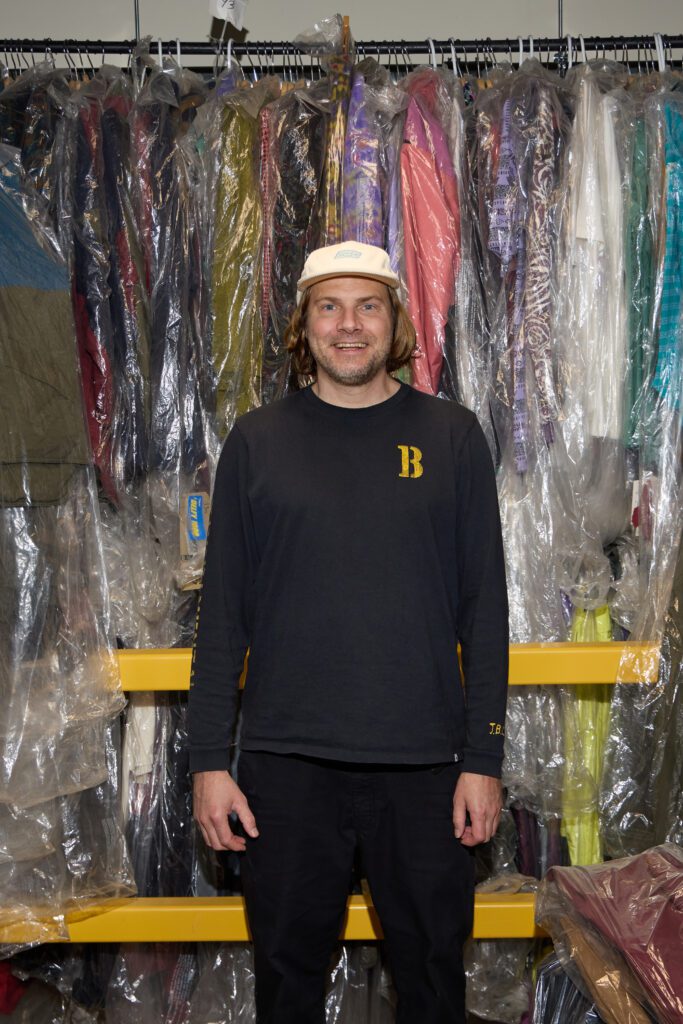
“It’s insane that he did a hundred different prototypes before settling on the production,” he says. “It just shows you his passion and not giving up, because this was still an era where people were kind of laughing at him, like it would never be anything. But he was so determined.”
They are handmade, built from different materials and in different shapes, and not all of them make much sense when viewed through what we now know a snowboard should be. But collectively they record something that the finished product cannot: the process of figuring it out.
And that pattern repeats throughout Burton’s history.
TK points to the company’s first attempt at step-in bindings in the late ’90s. It didn’t last. The system was heavy and, in his view, never rode like a traditional strap binding. But he doesn’t necessarily see that first attempt as a mistake.
“I think that needed to happen for Step On to be possible,” he says. When Burton returned to the idea years later, the lessons were already there. “Jake was like, ‘Let’s do it, but it’s got to ride like a regular strap binding, and it can’t fail like last time.’”
The second time around, the company spent years developing it. Preserve the failure and suddenly it becomes useful.
That idea feels particularly relevant now.
For Burton’s 50th anniversary, the company is moving back through its history decade by decade in five product drops across the season. The first revisits 1977–1987 through the 1985 Powder Shell kit, with another four collections set to follow through the winter.
Faced with fifty years of product, the question is not simply what Burton can bring back, but what is actually worth bringing back.
“It pretty quickly turns important to us internally,” TK explains when I ask when an old jacket or board becomes historically significant.
The softgoods department is constantly asking him to pull previous collections. Designers working several seasons ahead want to see what Burton did before, how something was constructed or what an idea looked like the last time it appeared. Shortly before our conversation, TK says around 50 items had been pulled from the archive for a future project.
The archive is being used.
And sometimes the process is less flattering to the past than nostalgia would suggest. A designer can remember something as perfect, only to pull it from the rack and realise that, actually, it can now be done much better.
Technical materials improve, fits change and riding evolves. Something worth revisiting is not necessarily something worth reproducing.
The Powder Shell is for example, originally released in 1985, Burton describes it as snowboarding’s first purpose-built outerwear jacket and pant. Forty years later, the silhouette, materials and demands placed on snowboard outerwear have changed considerably.
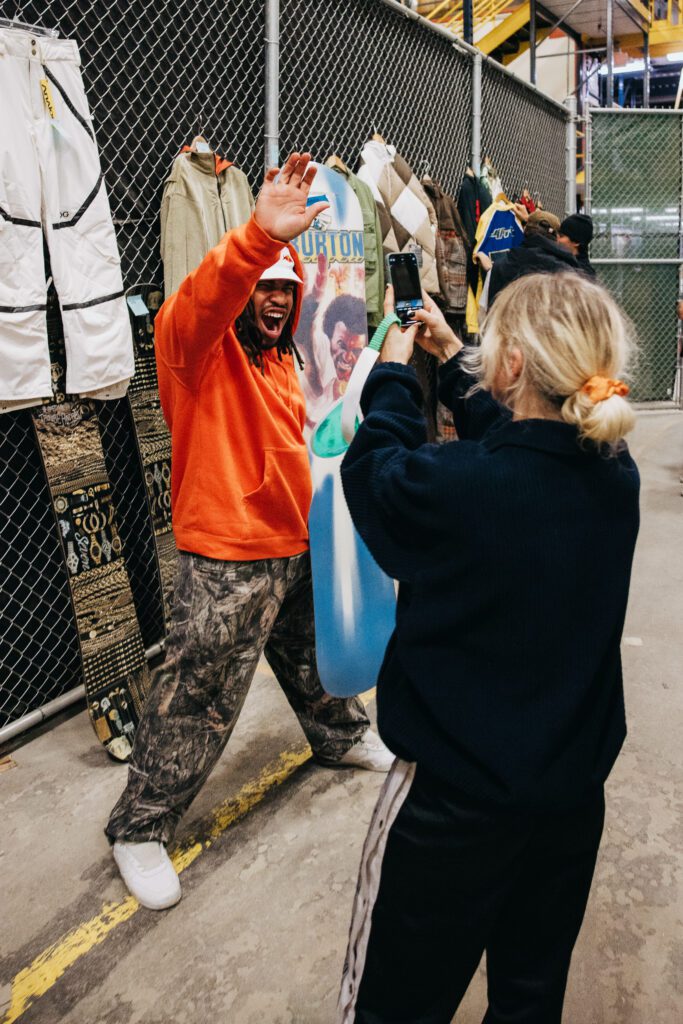
“It was really tight and small,” TK says of the original. “You wouldn’t ride in it nowadays.”
So the anniversary version keeps the visual reference while changing the proportions and updating the construction with modern 3L weather protection.
The idea is not to cosplay an old snowboarder. It is to work out what made the original worth remembering and carry that part forward. That distinction runs through the wider process of building the anniversary collections.
TK was involved alongside Christian Didrichsen, Mike Gratz and others in digging through the archive, discussing favourites and narrowing down what deserved another life. The current Burton team was part of that conversation too. When different boards were being considered for later drops, the riders helped decide which ones should return.
It´s refreshing to hear that the people selecting Burton’s history are not only the people who lived through it. When they bring younger riders into the archive, they often gravitate towards things TK doesn’t expect.
Zeb Powell became interested in an old Ronin pant with a barbed-wire print, something Burton had made roughly two decades earlier but which suddenly made complete sense alongside the way he dresses now. Grace Warner gravitated towards an Analog Q jacket from 2002; TK happened to have an extra one in his personal collection and gave it to her.
Other riders are wearing pieces they have found thrifting or inherited from their parents. Logos TK immediately associates with a particular period can look completely fresh to somebody encountering them for the first time.
There is something wonderfully destabilising about that.
A snowboarder in their twenties can come across a graphic from the early 2000s without any of the baggage attached to it. They don’t necessarily care about recreating the exact moment it came from. They just like it.
And perhaps that is one of the best tests of whether something is worth bringing back. Does it still work once you remove the memory attached to it?
TK hopes the anniversary drops can work in both directions. Someone who remembers the original may recognise the reference immediately. Someone who doesn’t can discover the product first, then become curious about the riders, videos and culture around the era that produced it. “They’ll discover it and maybe wonder what was going on in that era,” he says. “Who the riders were and what was going on.”
That doesn’t mean every part of snowboard history receives the same attention.
There are whole areas TK thinks have become less visible over time. Alpine and racing, for example, receive less attention today than freestyle, despite playing an important role in the development of the sport. He points to riders such as Peter Bauer and Jean Nerva and the carving movement around them.
Now that carving has become prominent again, those older threads suddenly feel more relevant.
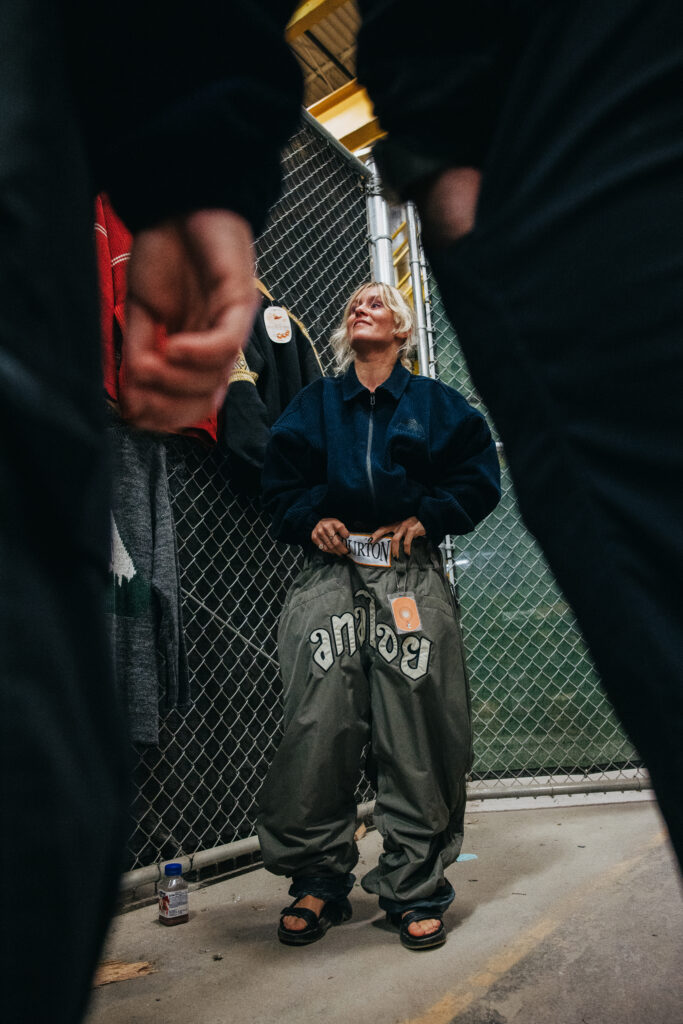
History rarely comes back exactly as it was. Sometimes it returns as a product. Sometimes as a silhouette, a graphic or a way of riding. Sometimes a new generation arrives at essentially the same idea without knowing much about the first one. It is also why fifty years of material does not necessarily provide a straightforward answer to what matters most.
Through Trippin’ with TK, Kohlman has spent time with collectors whose definition of valuable changes dramatically depending on when they entered snowboarding. Someone who started in the ’80s often cares about completely different objects from somebody whose formative years came a decade or two later. Pro models are particularly powerful because the product carries the personality of a rider with it, but there is no definitive list of what everybody is supposed to care about.
The archive can preserve the object. It cannot dictate what the next generation will find meaningful in it.
Near the end of our call, TK notices the 1987 Terry Kidwell 1650 hanging behind me. The conversation drifts briefly away from Burton and into the rivalry between Jake Burton and Tom Sims. Rather than dismissing Burton’s old competitor, TK immediately acknowledges how important that rivalry was. “We wouldn’t be as far as today without Sims,” he says. “Jake and Tom really butted heads, but the competition drove the sport so much more. I always respect Sims.”
Perhaps surprisingly for someone who made sure so much of Burton’s own history was preserved, Jake himself doesn’t sound particularly interested in turning that history into a monument.
TK tells me that preserving all of this was ultimately Jake’s vision. He saved things, remembered things, and could recall patterns or products from years earlier and ask TK to find them. But when the archive eventually gained a museum space, TK remembers Jake telling him, “You finally got your museum,” almost as though he had reluctantly conceded the point.
“He was definitely focused on the future,” TK says. “Whenever we talked, it was always, ‘What are you riding now? Where did you ride?’ More future stuff. Not the past.”
Somewhere in that conversation, an image comes into my head: every board Burton has ever made stacked underneath you. The pile isn’t there so you can keep staring down at it. It simply puts you high enough to see a little further ahead.
“Exactly,” TK says.
Maybe that is the better way to think about fifty years.
Not as fifty years of things deserving another turn simply because they existed, but as fifty years of experiments to choose from.
Some deserve to come back, some make sense only once they have been changed and others are more useful as reminders of what not to do.
And somewhere on those shelves is a snowboard with an extra metal edge underneath because somebody once genuinely thought it might be the answer.
It wasn’t. But knowing that is useful too.
From rails and side hits to big jumps, our pick of the

Our Pick of the Best Splitboards for Backcountry Adventures in 2026/2027 Looking

From playful freestyle boots to stiff, precision-focused all-mountain options, we take a
