

Best Snowboard Bindings for Winter 2026/2027
Our pick of the best snowboard bindings for winter 2026/27, from playful



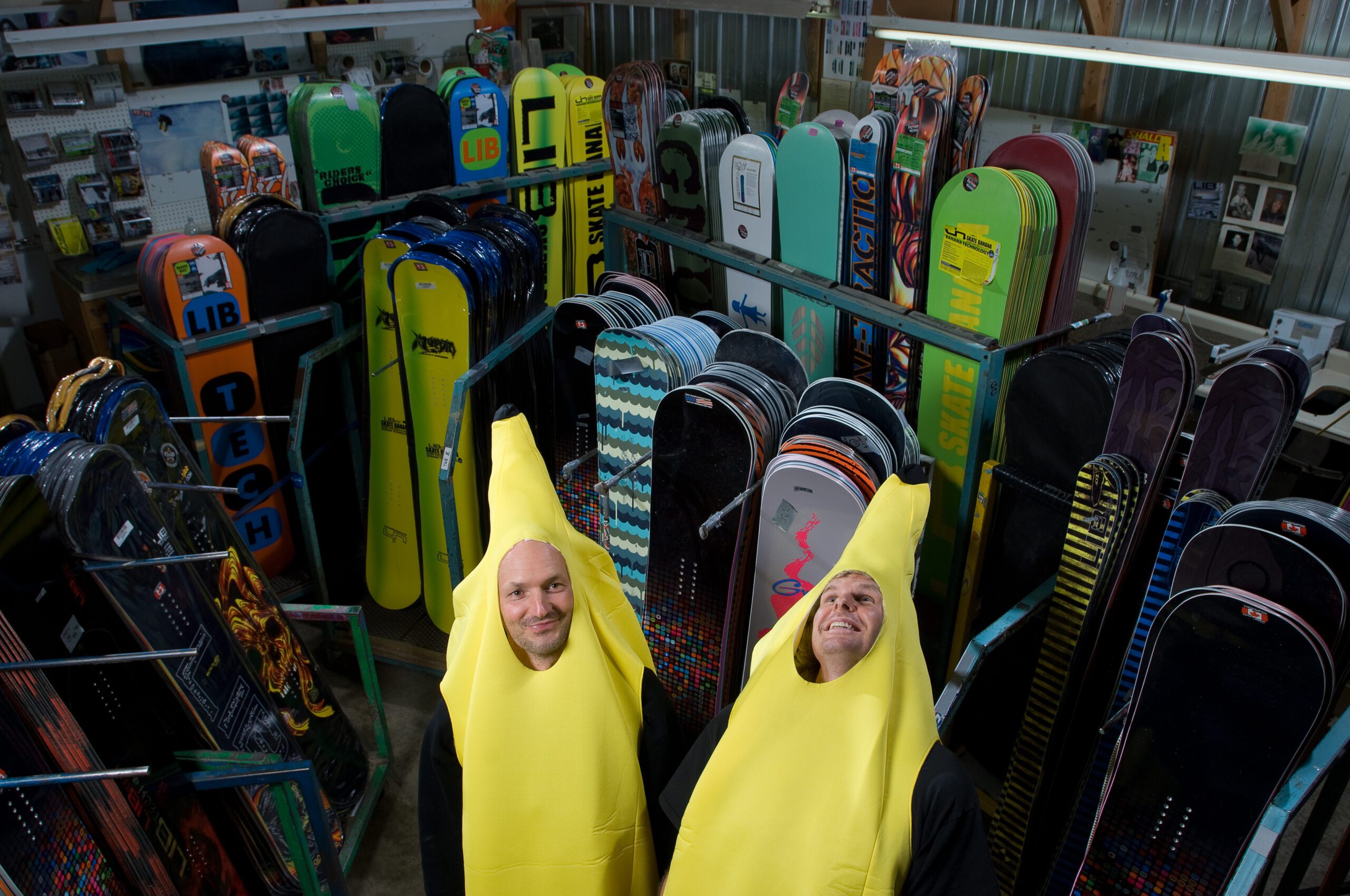
Q&A with Pete Saari, Co-Founder of Lib Tech.
Twenty years ago, Lib Tech did something that, at the time, seemed pretty radical: they bent a snowboard the wrong way.
The Skate Banana arrived in 2006 with rocker between the feet, Magne-Traction under the edges and a completely different idea of how a snowboard should feel. It was playful, forgiving and different enough to raise a few eyebrows, but it also worked. Two decades later, rocker and hybrid profiles are everywhere, while the Skate Banana itself is still going strong with its original design largely intact.
To celebrate 20 years of one of snowboarding’s most influential board designs, we caught up with Mervin co-founder Pete Saari to go back to where it all started, how the industry reacted and why, after all these years, the Skate Banana is still one of their best-selling snowboards.
Twenty years of the Skate Banana. Does it feel like it’s actually been that long? What do you remember about developing that first board?
Slippery subject. It feels like yesterday. I pushed hard to make this project happen and remember absolutely everything. We are a hands-on product development team that loves creativity, snowboarding and is constantly looking to improve performance. Mike Olson and I [Pete Saari], who founded Mervin, have a lifetime of experience skateboarding, skiing, snowboarding, surfing and building boards to achieve higher performance or specific goals.
Snowboarding has always been magic, especially in powder. A lot of the early snowboard contours included fins and rockers that worked great in pre-lift-access soft snow conditions. In the early 80s, Mike Olson’s early powder designs worked well enough in slush or rainy soft snow that he was able to convince local resort manager Bill Moffat to let him ride the lifts at Ski Acres (now Summit Central).
Access to the mountain without hiking was amazing, but it also presented new terrain challenges, including hardpack, moguls and the dreaded PNW post-rain freeze ice. Mike addressed these challenges by combining ski and surf design concepts, introducing deep progressive sidecuts on his early GNU finless boards that pioneered modern resort snowboard design.
We tested those early deep sidecut boards at Ski Acres, and the deep carving, trenched pin lines we saw looking back at our tracks from the chair blew our minds… they were the first of their kind.
I digress… the point I am trying to make is that we specialise in radical change, and our tooling is specifically adapted to make new ideas both affordable and achievable. Most snowboard and ski companies have very expensive tooling, in the 5k to 20k range, to make a new tool, which severely inhibits the desire or ability to innovate. It’s hard to be creative when you have to talk ROI as the first hurdle in the plan to make new toys.
Over decades of board-building experimentation and refinement, we had set ourselves up to have no internal obstacles in our way to push snowboarding forward, and the Skate Banana came as one of the pinnacle products of all that dedication and effort.
Take us back to snowboarding in 2006. What were boards generally like at the time, and what made you start questioning the traditional camber shape everyone was riding? Where did the original idea for Banana Technology actually come from?
Snowboards in 2006 were fairly homogeneous pill shapes and all built with ski-inspired camber. For the most part, we are freestyle-minded freeriders, but being from Washington State, we become a race-board design company for three months of the year as our in-house crew riders try to win their divisions of the legendary Mt Baker Banked Slalom. At the time we developed the Skate Banana, we had come off developing Magne-Traction serrated edges as part of that effort to make snowboards perform better on firm terrain.
Magne-Traction was exciting, but we were still frustrated with snowboard performance on hardpack and ice. It felt like skateboards and surfboards worked better in their environment than snowboards did on snow, especially on heelside turns.
The cambers used on snowboards at the time were derived from ski theory, based on one single pressure point being applied to the centre of the ski. Snowboarding is done with two feet applying pressure on a shorter board, leaving a lot to be desired in terms of pressure distribution along the edge.
Rocker had been a key component in early snowboard design, but as snowboarding progressed into resort riding, it had been abandoned in favour of ski cambers. Mike Olson, Steven Cobb and I decided to reintroduce a very specific rocker profile between the feet that would pressurise and “wake up” the middle of the snowboard.
The first prototype we built incorporated a “flat banana flat” layout. I took it up to Ski Acres with my family and still remember the uneasy feeling riding up the chair, wondering how it would go on the steep icy down ramp. It held perfectly and arced into a smooth one-footed carve, and I immediately knew we were onto something.
The pre-arced rocker between the feet made turning and carving effortless. The reduced tip and tail pressure made the board catch-free and playful for freestyle progression, and the added float in powder in both directions was incredible. We got Temple and Jesse Burtner on them immediately, and they both loved the new sensations: Jesse for the freestyle freedom and Temple for the positive edge hook-up, carving efficiency and float. Snowboarding was instantly easier and more fun for all.
It sounds simple now because rocker and hybrid profiles are everywhere, but at the time it was pretty radical. When you first showed people the Skate Banana, what was the response like?
We were very excited about it. We got lots of pros, including Jamie Lynn and Travis Rice, on Banana Tech, and they initially loved it. With more experimentation, some missed the stability camber provided at the tip and tail, which led to our C2 Camber Rocker Camber hybrid designs.
Our reps and some dealers at the time were tripping. They had just begun to process Magne-Traction serrated edges, and now we were turning snowboarding upside down again a couple of years later. Dealers loved it once they tested it because the Skate Banana hybrid design made snowboarding easier and more user-friendly… people had better first days on the hill, which is great for snowboarding as a sport overall.
Our competition hated it. The expensive tooling I described earlier made radical changes to design driven by another brand not only annoying, but expensive. Most brands didn’t acknowledge hybrids as a legit concept for a couple of years, and by then we had refined them into an entire category of board design with variations tuned to different riding styles and terrain. We loved the hybrid Banana Tech hate; you can still hear it from some of our industry competitors today.
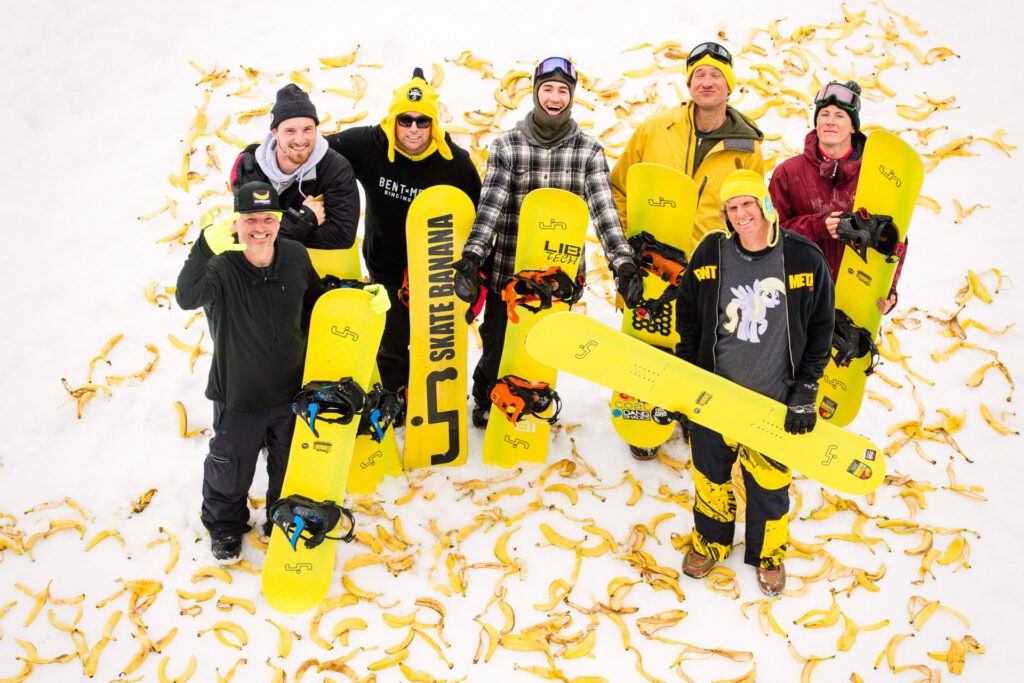
For someone who has never ridden one, can you explain what Banana Tech actually does and how that translates to the feeling under your feet?
Banana Tech makes a board easier to ride, easier to carve, easier to progress and land tricks on, and easier to float in powder in both directions. It makes your first day much easier and learning overall much more fun.
Banana Tech spreads the load in a way that puts more pressure at and under your feet and depressurises the tip and tail, making them less catchy and more floaty. The rocker puts a natural arc between your feet when you put the board on edge, making it want to turn easily.
Magne-Traction is another huge part of the Skate Banana story. How did those two technologies work together to make a rocker-dominant board perform on hardpack as well as in softer snow?
Magne-Traction and Banana Tech are both targeted at making snowboards work better, with a focus on managing the “dead space” – the unpressurable area of the board between your feet.
Magne-Traction is a serrated edge concept that focuses edge pressure and hold into specific areas at the high points of the teeth. Banana Tech puts a reverse curve in that same area between your feet, focusing pressure into the centre of the board and working with Magne-Traction to bring even more energy and life to the centre of your board. Easier, more positive carving on hardpack and ice is what you get when you put the two together.
The Skate Banana went on to influence a whole generation of snowboard design. When did you first realise this wasn’t just another board in the Lib Tech line, but something that was genuinely changing how people thought about snowboard shapes?
We have always been surfers who ride every kind of shape and size surfboard imaginable. Surfing uniquely has a low cost of entry for new designs, with backyard shapers being able to design whatever they want. This creates an exciting creative environment for designers and surfers to constantly think outside the box and experiment with shapes in search of the magic board.
Our low-cost-of-entry prototyping process opens those same creative doors for our snowboard development team. We love experimenting and riding new concepts, and it feels like quite a few brands have followed our Experimental Division lead.
With the Skate Banana, Mike and I had talked about all the benefits of the hybrid design before we even rode the board and pretty much knew it was going to be great. But the moment I took three turns off the lift at Snoqualmie Summit Central, I knew for sure we were right about the concept.
All the design elements had always been there, but we put them together at a time when snowboard design was stagnant and needed something disruptive and creative to make it more fun.
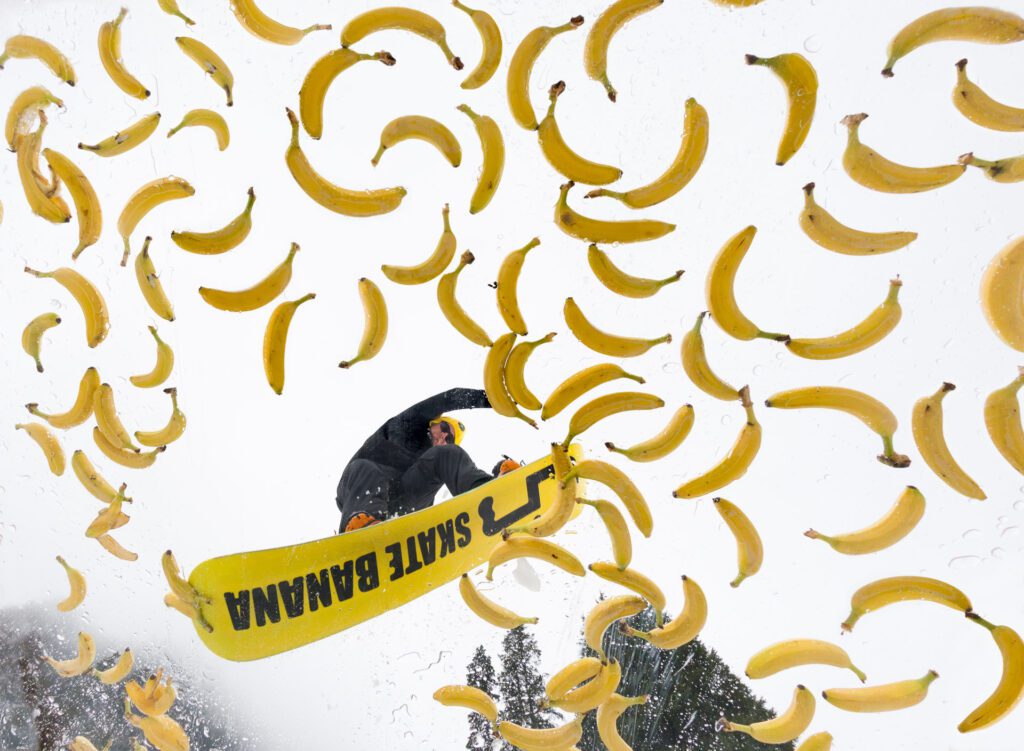
What did the Skate Banana unlock for riders? Did you start seeing people approach freestyle or the mountain differently because of how forgiving and playful the board was?
We are riders, so for us it unlocked a lot of good times. Experimenting with carving 360s on hardpack became one of Olson’s obsessions and fuel for some of his other personal designs like the Banana Magic. I loved the playful freestyle freedom and confidence I felt pushing myself onto rails and park features in my 40s, and the hardpack carving and pow float switch and normal opened lots of doors for smiles and progression.
Riders like Jesse Burtner really were able to celebrate their passion for expanding what is possible creatively freestyle-wise on a snowboard. Scott Stevens spent some time that first summer on the Skate Banana with Jesse at Mt Hood, and those two really pushed into some new spaces that are still expanding today.
The Skate Banana also forced designers to re-evaluate cambers and develop modern snowboard-specific cambers that are more efficient and work better than cambers of the 80s and 90s.
Twenty years is an incredibly long life for a snowboard model. Why do you think the Skate Banana has stuck around when so many boards have come and gone?
The Skate Banana stuck around because it is genuine, functional visible technology that really captures the essence of what people and shops want in snowboarding. It’s playful, fun, easy to ride and absolutely rips if you want to take it to the next level. Any time you strap into a Skate Banana, you know you are going to have a good day!
How much has the Skate Banana actually changed over those 20 years?
The design remains pretty much unchanged from the original launch design… we have made a few subtle refinements to our production process and Magne-Traction variations, but the Skate Banana was pretty much perfect from the get-go.
Where does the Skate Banana sit within Lib Tech today?
The Skate Banana is consistently one of our top five selling boards and still beloved by our riders and in-house crew. It’s kind of like a fish shape in surfing… fish surf shapes have been around for 50 years since Steve Lis popularised them, but anytime you take one out you know you are going to have a great time, and people keep adding new twists to them.
Is there a particular rider, video part, contest, trick or moment that sums up the board for you?
I love Austen Sweetin playing with one at Whistler on a soft-pack resort day. Jesse Burtner has endless amazing clips on the Skate Banana, and Brandon Reis has been Backyard Boardin’ his Skate Banana into all kinds of fun and mischief.
There is a poster of Jamie Lynn doing a method on a Skate Banana through a forked branch of a tree in Japan that always makes me smile. Martin Cernic, currently the CZ national team coach, won a bunch of contests on the Skate Banana – slopestyle, pipe, etc. – and still rides it as his go-to board for all conditions today.
For the 20th-anniversary model, did you ever consider doing something radically different, or was staying true to the original Banana Tech part of the point?
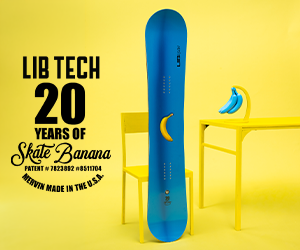
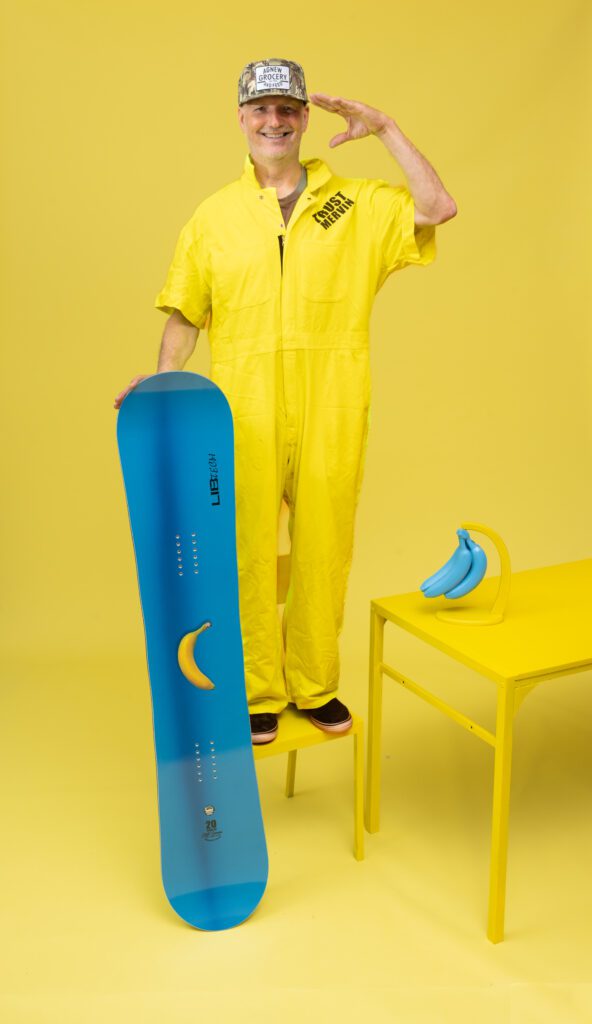
We wanted to stay true to the original design… it rips and always has. We wanted to make sure the art was fun and memorable like the original, but new. Annette Veihelmann, our Lib art director/graphic designer, worked on this year’s concept with a lovely blue background and an iconic banana.
If you could put the original 2006 Skate Banana next to the 2026/27 version, what would those two boards tell us about how snowboarding itself has changed over the last 20 years?
I have both in my office, and they remind me to keep pushing and experimenting and that having a factory to make toys in every day is a privilege that Mike and I worked really hard to have and share with our friends, riders and all of snowboarding.
We are still excited to come to work every day and make good things happen, and thrilled people like Matteo Soltane have joined us to put their energy into pushing snowboarding forward into the future.
And after 20 years, what does the Skate Banana mean to Lib Tech?
The Skate Banana makes smiles and moves units, baby! …Joking, but hybrid contours do make up over half our board sales every year, and variations of Banana Tech and Magne-Traction are popular for many brands.
Our pick of the best snowboard bindings for winter 2026/27, from playful
Our pick of the season’s most versatile snowboards, from first turns to

From deep powder to steep lines, our pick of the season’s freeride
