





Red Bull Heavy Metal 2026 Made Its Mark on Helsinki
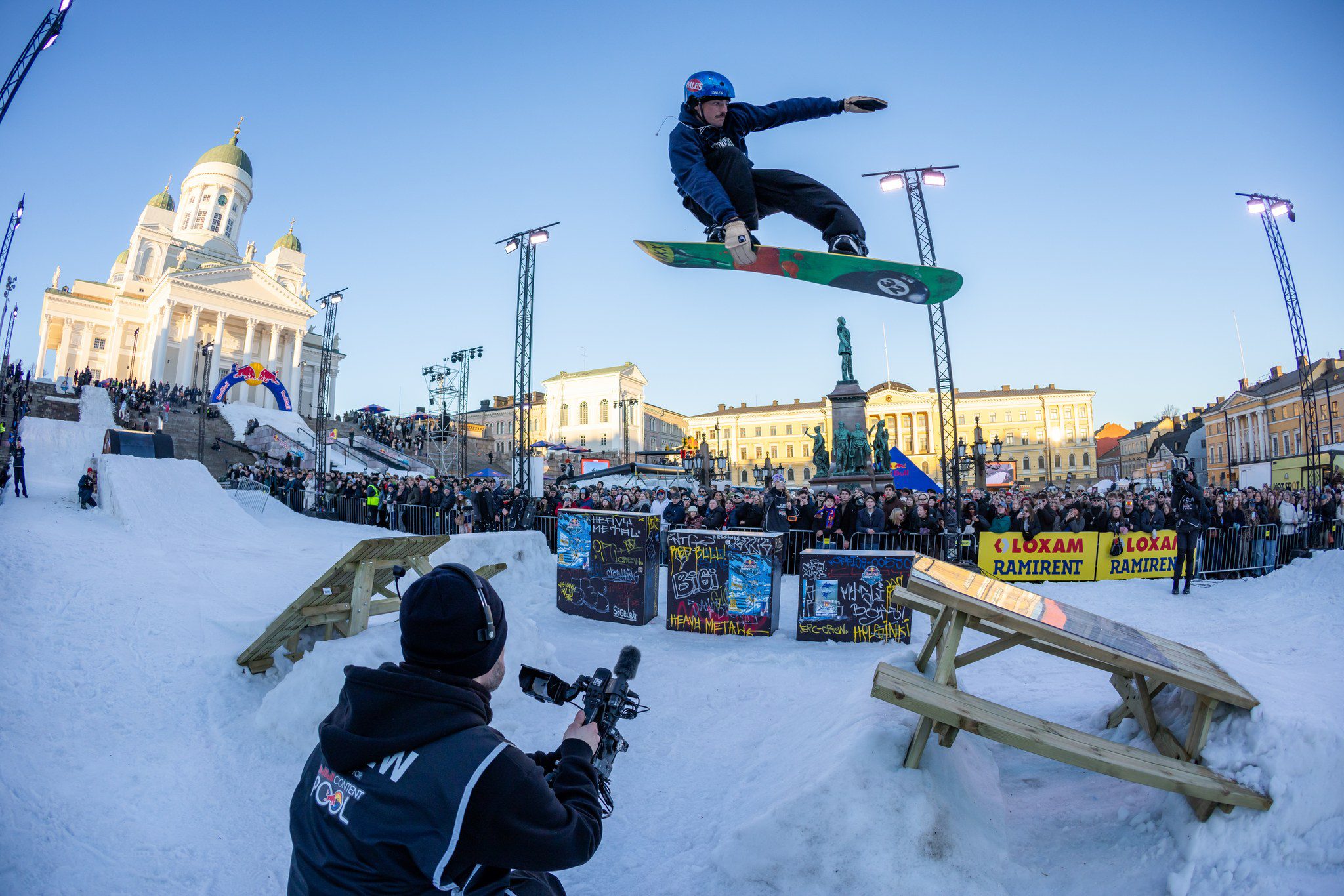
One of snowboarding’s most iconic rail jams filled a void the Finnish



WORDS: ALBA PARDO
If there’s one thing snowboarding keeps giving me, it’s a reason to point at a faraway spot on the map and dream about the mountains there. The opportunity to explore and discover new places through the snowboarder lens is both a privilege and a commitment. New countries are always a thrill, but it hits different when new also means unexpected. Georgia, tucked where Europe shakes hands with Asia, between the Black and the Caspian seas, was one of those places I never quite imagined I’d ride. And then I did.
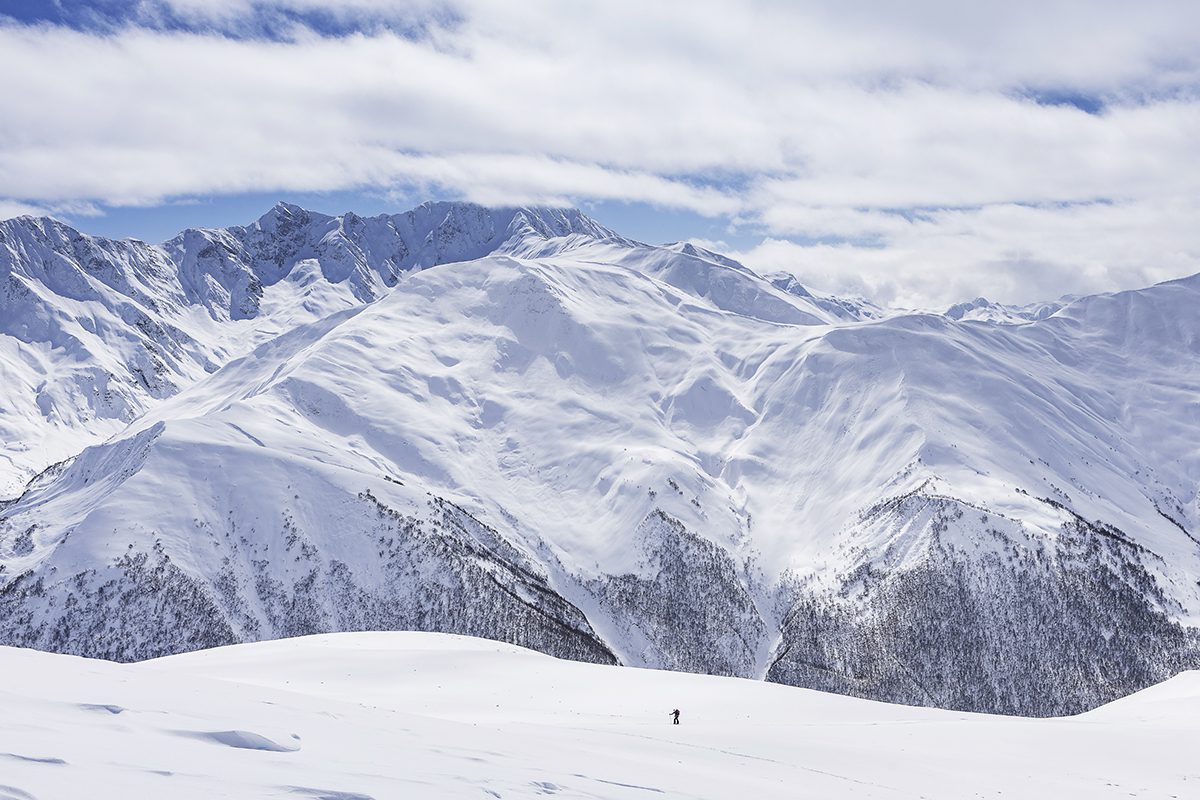
Thanks to the Freeride World Tour putting unlikely freeride zones on the map, Georgia is now firmly on the radar. The Georgian side of the Greater Caucasus rises in abrupt walls and cathedral spires – Shkhara (5,201m) dominating the skyline with Mount Elbrus looming just beyond the border, and the double-headed Ushba (4,710m). For many, Georgia exists as a vague dot between seas; in reality, it’s a border symphony: Turkey to the southwest, Armenia to the south, Azerbaijan to the southeast, Russia to the north – right where continents blur and history gets complicated. On a map, it’s close to conflict zones; on the ground, it’s a powder frontier.
From a traveler’s perspective, it’s a dream. From mainland Europe, it’s one of the shortest flights you’ll take to feel this far from home. In a few hours, you tumble into Tbilisi, where steel-and-glass modernity shares sidewalks with peeling facades and wooden balconies. The countryside is even more modest: stray dogs with places to be, cows and pigs walking main street like they’ve got errands, and the smell of home-baked goods in the most unexpected corners.
Winter makes the tribe visible: familiar outerwear at baggage claim, eye contact, the nod. You know, none of us flew in just for the cheese bread.
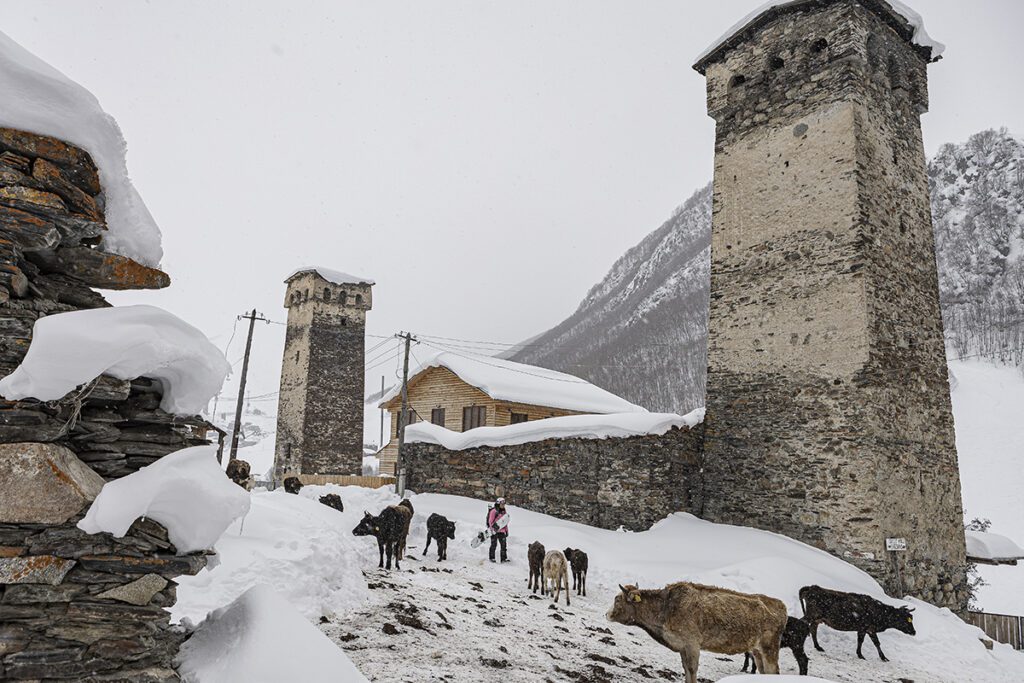
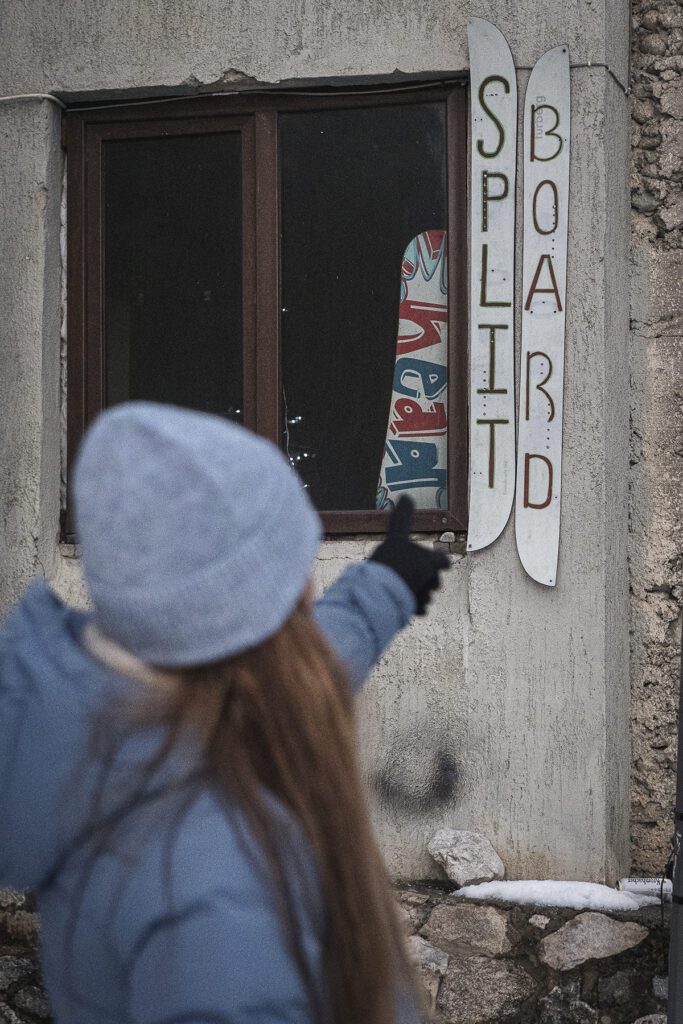
I started alone, tuned in to all the subtle signals you read when you travel solo. I never felt unsafe, in the capital or the villages, but I felt smarter the moment I linked with locals. In Georgia, a guide isn’t just avalanche eyes and route-finding; they translate the place: the weather, the unwritten road rules, and show you how to drink chacha.
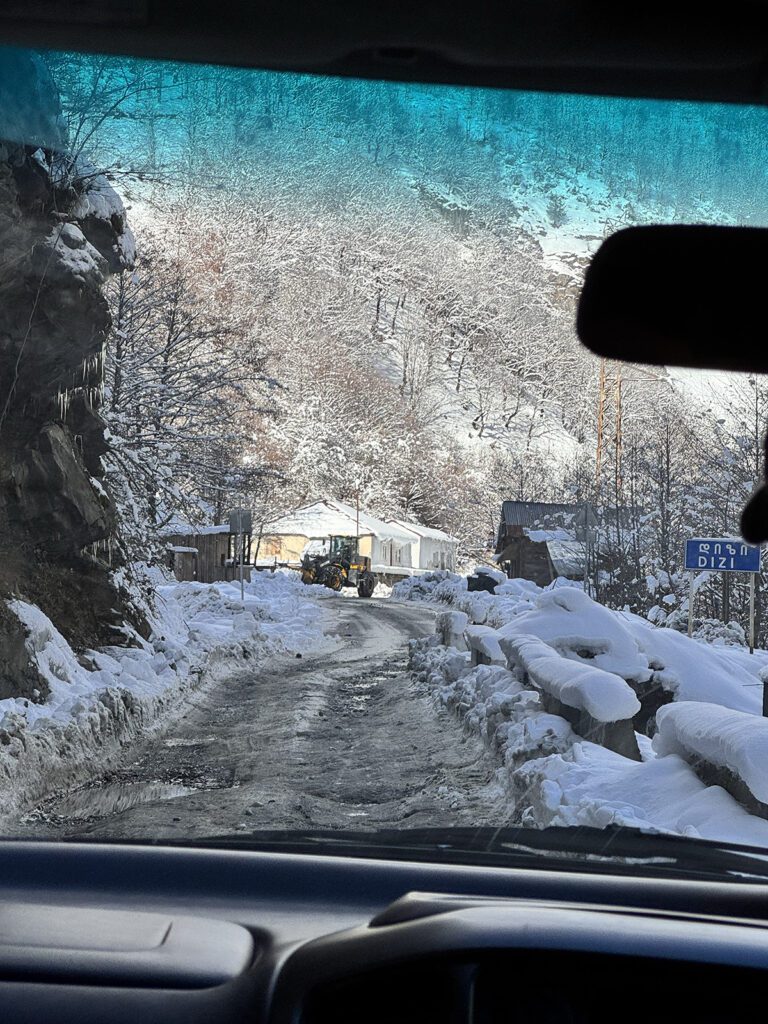
Tbilisi to Mestia is eight to nine hours on paper. When it was our turn, the south had been hammered by snow, and the highway drove like a frozen river. We passed buses when gaps appeared, braked for livestock, and finally turned west for the climb – Zugdidi to Mestia: four hours of bumpy, narrow roads, and animals everywhere. Our driver, Gaga, piloted a Japanese 4×4 van on tractor-grade tires, snorkel jutting through the roof like a periscope. When he carried speed under slide paths and overtook every car in front of us, I assumed he was rushed; later, he shrugged and said it’s safer to move quickly where snow and rocks might come down. I can’t prove the physics, but I trusted the local logic.
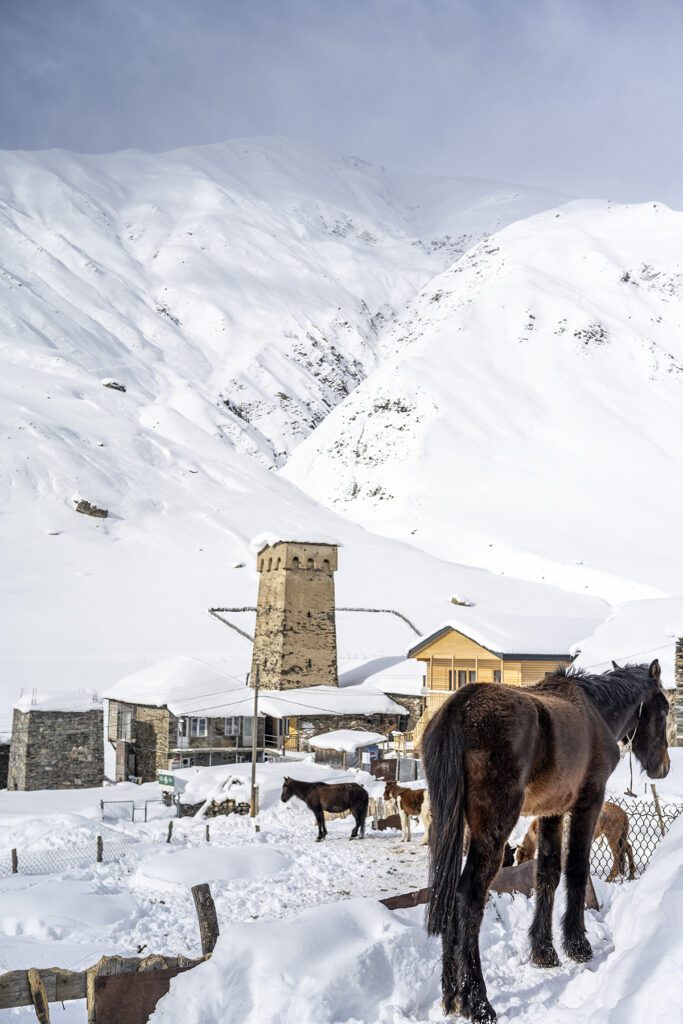
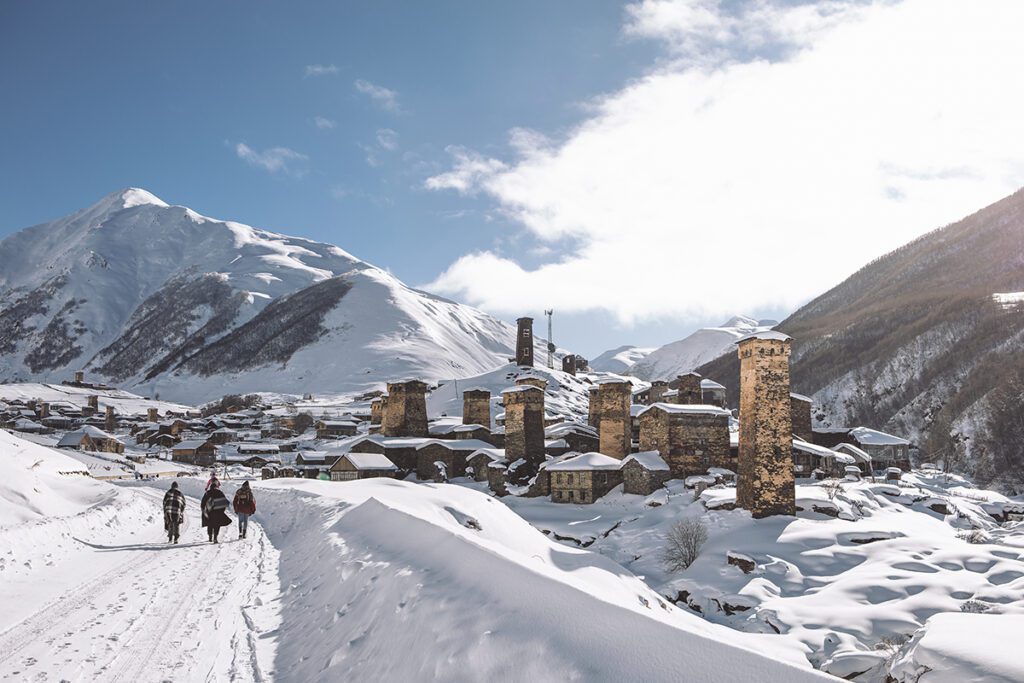
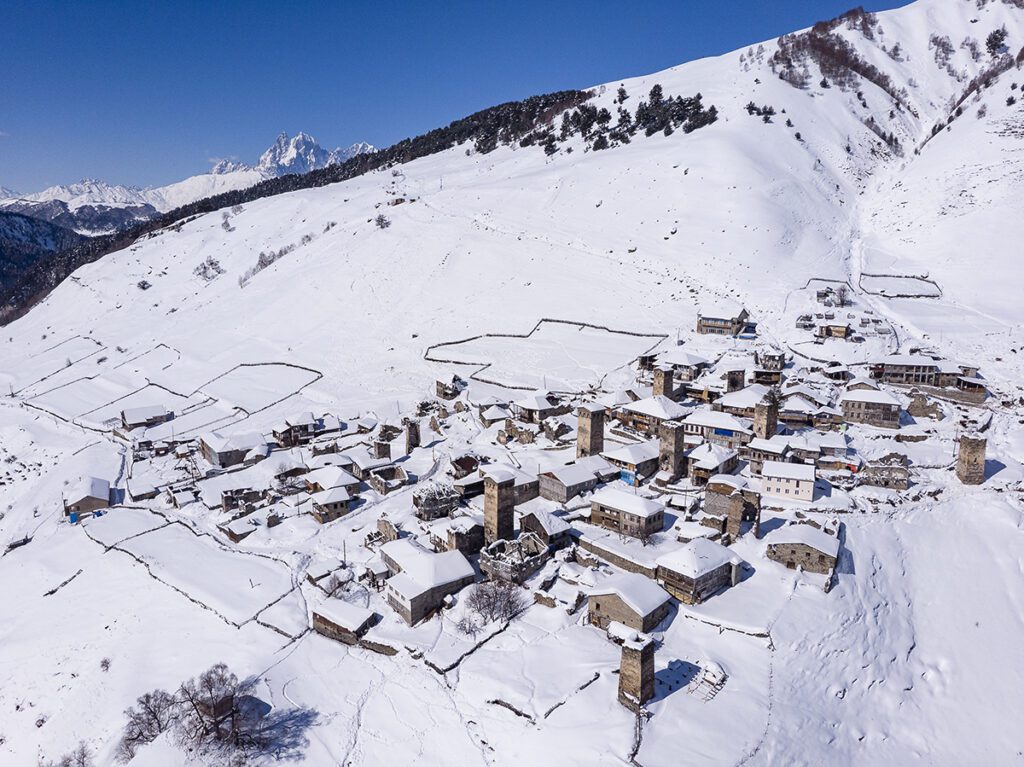
Somewhere on that second leg, the “middle of nowhere” feeling sank in. The big peaks all around us and stone towers began appearing in the fields – the Svan watchtowers, stubborn against time – reminding you that people have survived winters here for centuries. We all took our phones out and filled them with bad photos through the muddy windscreen. It was hard not to.
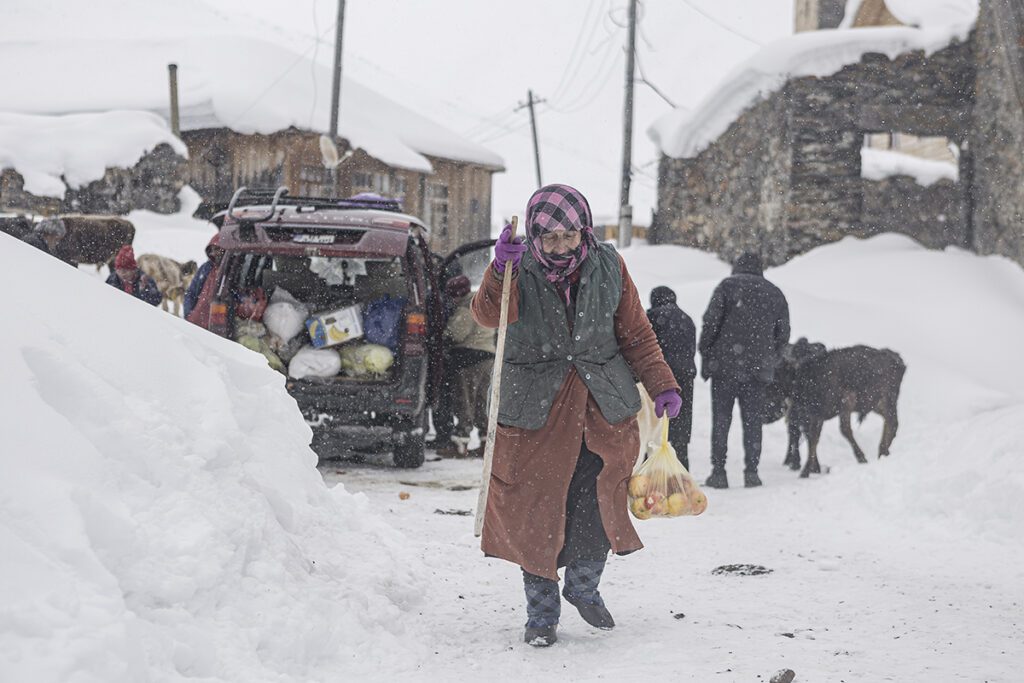
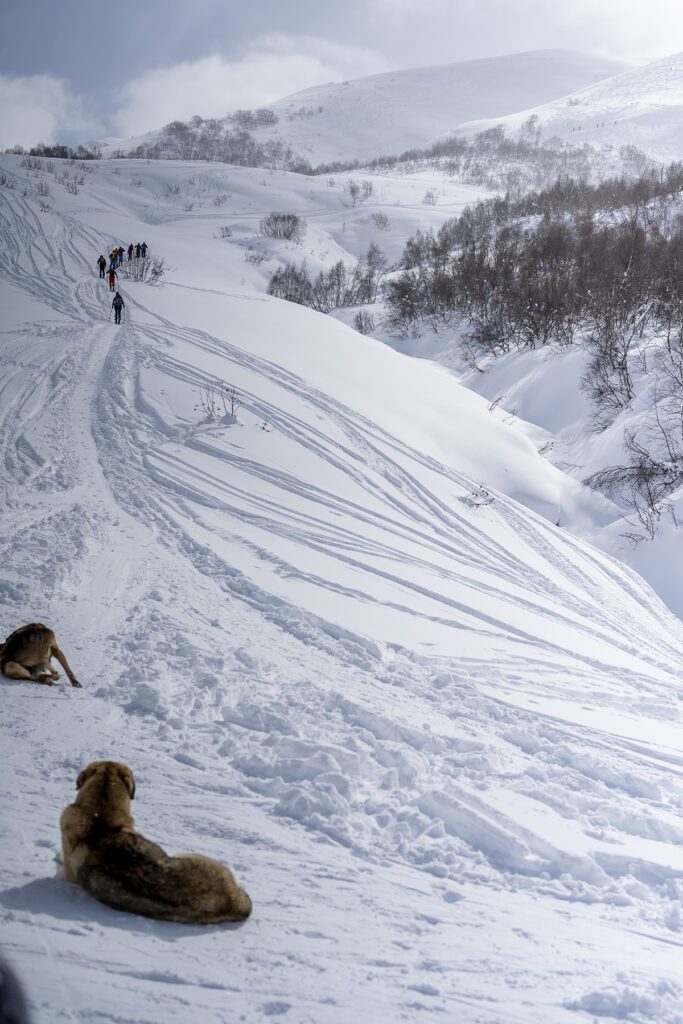
Svaneti is the highest inhabited region in the Caucasus, and it rides like it. Four of the range’s ten highest peaks live here. Beyond Shkhara, you read familiar names off the horizon – Tetnuldi (4,974m), Shota Rustaveli (4,960m), Ushba (4,710m), Ailama (4,525m), with Lalveri, Latsga, and more carving out the skyline.
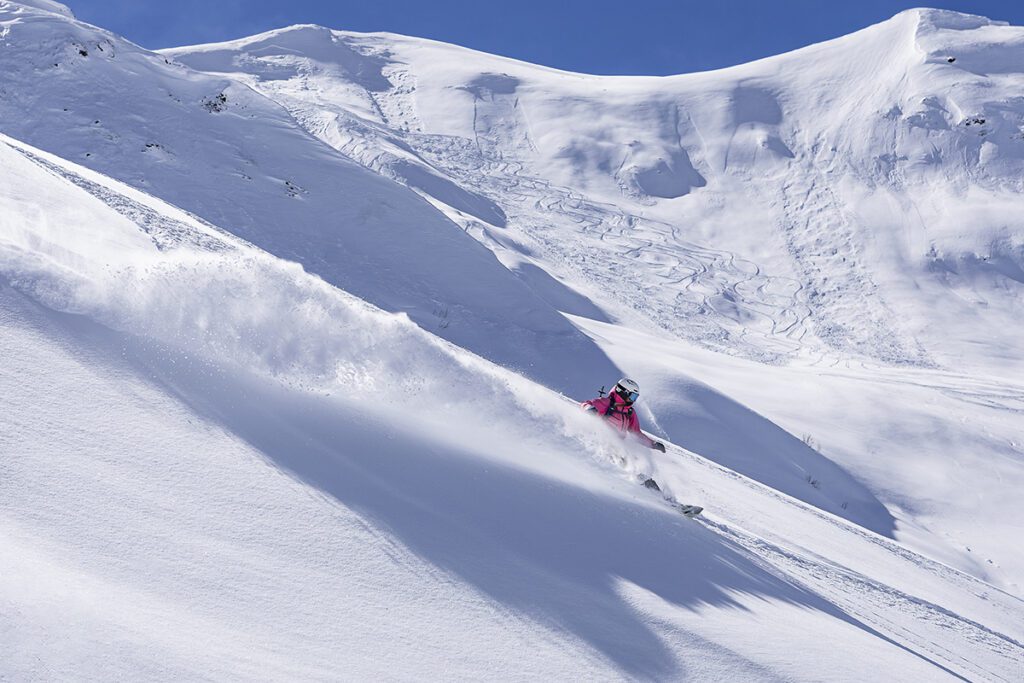
Mestia is the hub and the powder hound’s basecamp. Tetnuldi sits up the road – a 40-minute drive on a rather torturous road. Due to the high risk of avalanche and the conditions of the face for the Freeride World Tour competition the next day, the top part was closed to the general public, but we were able to sneak in and enjoy a few runs on the side of the slope where we carved some untouched pow, but the bottom quickly got tracked, and up top, just a short traverse across from where we were dropping in, lay a perfect, untouched slope that we were dying to hit. But our guide, Tite, didn’t even allow us to indulge the thought. “It will break, it will break very soon, and it’s a very long exposed slope, so you don’t want to be anywhere near it when that happens.”
As the work to secure the top face for the competition continued, an avalanche triggered on that face, making it unfeasible for the competition. Therefore, they had to look at a different spot to continue with the contest a few days later.
We decided to turn around and keep on riding if the pros couldn’t give us a show, still with our eyes on that untouched and so accessible face that exited just above the bottom lift. Perfect to lap some sidecountry runs. As we were about to exit on the side, keeping to the tracked-out area, we heard a strong roar and witnessed a group of 12 to 15 skiers quickly moving to the riders’ left to avoid staying on the avalanche path. An avalanche that lasted for minutes, it just kept going, on the very long, perfect slope that we were craving so badly, and our guide had forbade us. Any hard feelings of disapproval we might have had for him instantly dissipated as we witnessed another skier at the eye of the avalanche riding in front of it, slightly to the side, and definitely not out of danger, without even knowing what was behind him. We were all yelling at him to change his course until he realized and reached a safety island. This was day one, right next to the resort.
We knew there had been a massive snowfall in the previous days and the snowpack was unstable, but in the travel haze, we weren’t quite aware of how unstable it was.
When things like this happen, it’s when you realize just how important local knowledge is, crucial for the success, safety, and enjoyment of the adventure ahead.
The following day, in an attempt to experience more of the remoteness and untouched powder, we ventured to Ushguli, about an hour’s drive from Mestia, further into the mountains, where it feels like the end of the road. It probably is, actually. Ushguli is the mecca for tourers as it offers access to unlimited terrain, starts with friendlier fields, climbs through a safer ridge and allows you to choose the slope and the face depending on the conditions.
There, it’s common to have dogs follow you all the way to the top, as long as you share your snacks with them. Despite being stray dogs, they all look quite healthy and well-fed. We later learned that the Georgian people love dogs and really look after the street dogs, feeding and tending to them. They aren’t bothered at all by them; they like having them around and happily share a bit of khachapuri. During the climb, they were our unpaid guides and took rests when we admired the views to the magnificent Shkhara and Ushba. To think they are among the highest in Europe, after Mt. Elbrus, is quite humbling. The dimensions are quite hard to grasp with that backdrop.
That day, we still had to keep to the more mellow slopes, but the powder was deep and always fun, so by the time we made it back down, we were quite happy to end in a local restaurant behind a derelict farm where they served us a feast. I’m not sure what it was called, but it was delicious, and we had earned it!
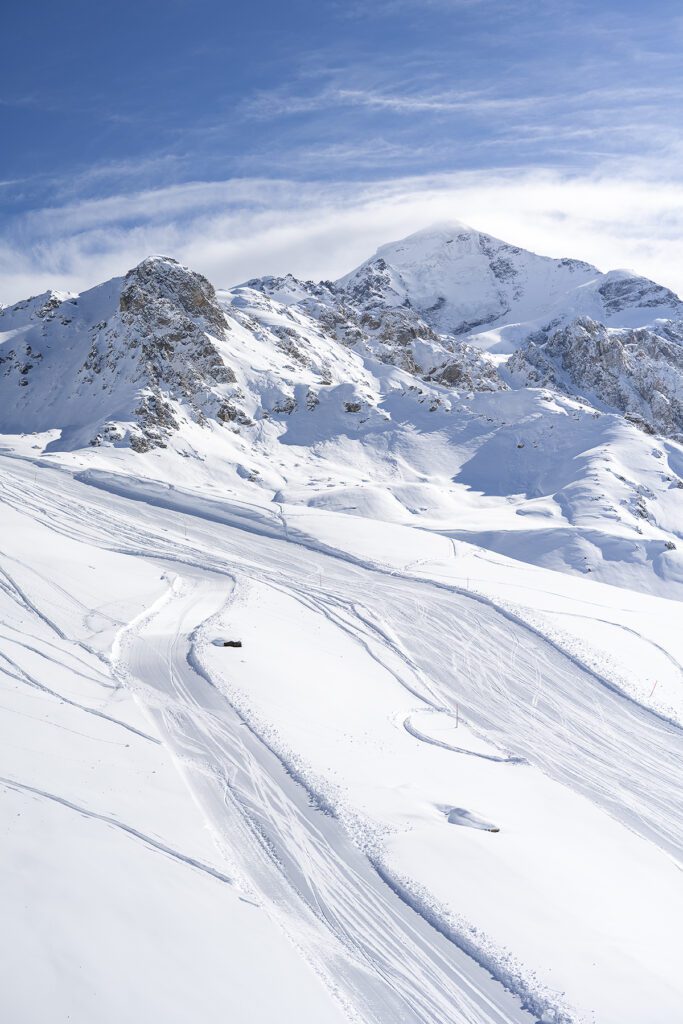
During the trip, we also got to visit Hatsvali, the closest resort to Mestia, with a brand new gondola that made lapping a dream. Kinder slopes, some trees, and skin tracks peeling off the top lift that took you to where you wanted to be.
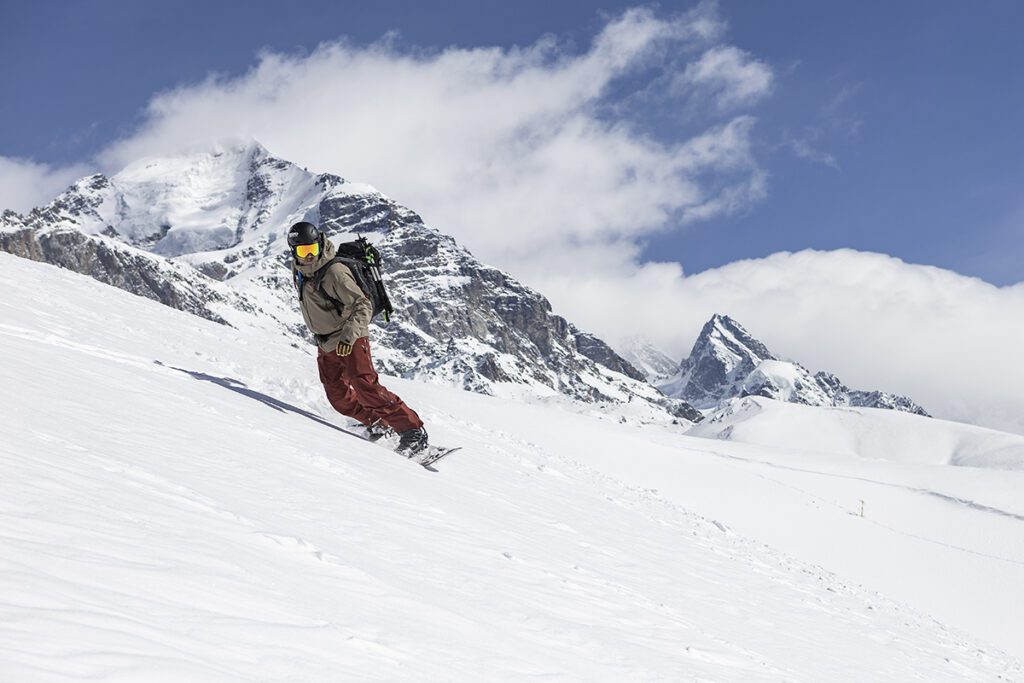
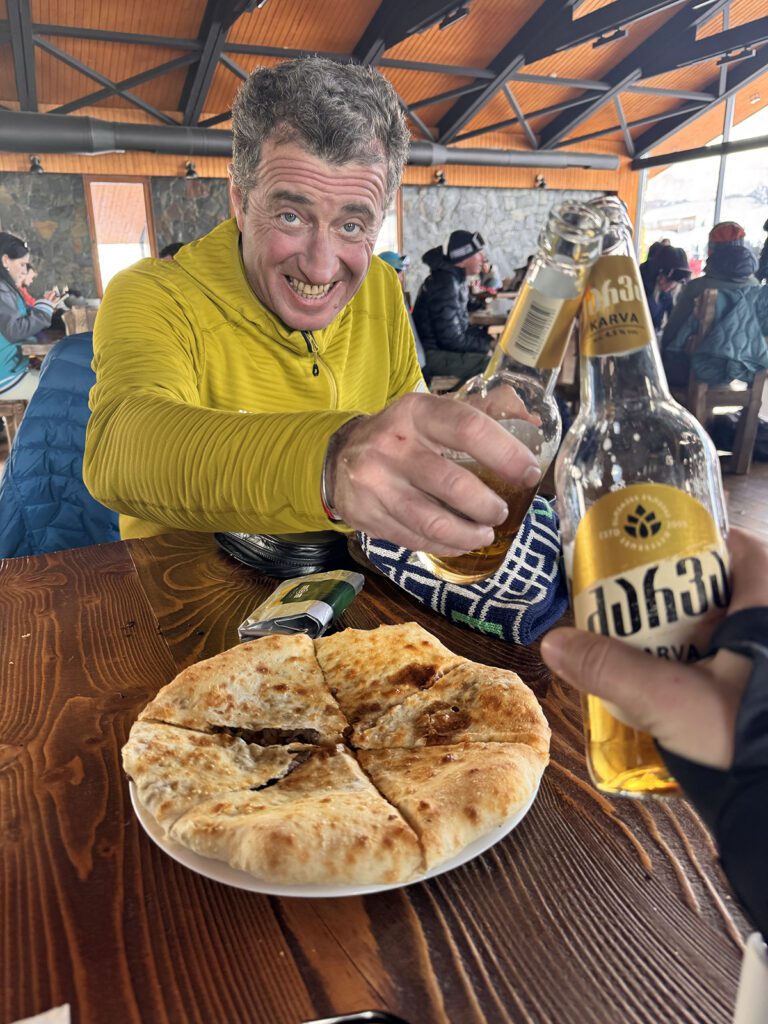
Georgia is a country full of contrasts. Gold-tipped monuments and brutalist government blocks. Curated city dining and steaming street markets. One day you’re lapping lift-served pow; the next you’re skinning in silence, listening for whomps and watching crowns. The snow count is generous and mixed with the temperature swings that are more and more common across the globe results in an avalanche risk that keeps you honest. Guides matter here – not just for the best lines, but for making the right calls when the mountains start talking.
We met with Ilia Berulava, the head of the Georgian Mountain Guides Association in Mestia, and had the opportunity to swap notes and learn a little bit about the Georgian scene. I came away with two takeaways: winter operations are growing fast, and the demand curve is steep. There are more than double the summer trekkers than winter clients for now, but the freeride scene is surging, and the guide pipeline is racing to keep pace. Georgia’s “secret” is becoming a rumor.
With the Freeride World Tour banners flying around town for a couple of years now, the town buzzes even in the coldest evenings, with the local food market and traditional dance shows, the celebration of the local culture and the international scene meet right there in the square, with the perfect excuse to warm up from the inside out with big sips of their infamous homemade chacha.
But make no mistake, Georgia isn’t a one-resort wonder. Gudauri, the country’s biggest ski domain and closest to Tbilisi, delivers quick access from the city and all of what you can expect from a world-class resort. Bakuriani is more family-friendly and also hosted the Freestyle World Championships in 2023. If you crave the untracked, Bakhmaro is the newer cat skiing spot with its own weather story. But it’s Svaneti – with its rocky towers against the big peaks, the powder against stone that burrows under your skin.
Come just for the snow and you’ll leave with more: words you can’t quite pronounce but will later crave, stories as filling as the khachapuris stitched with steep road turns, and the sense that the edge of Europe might be the center of your winter.
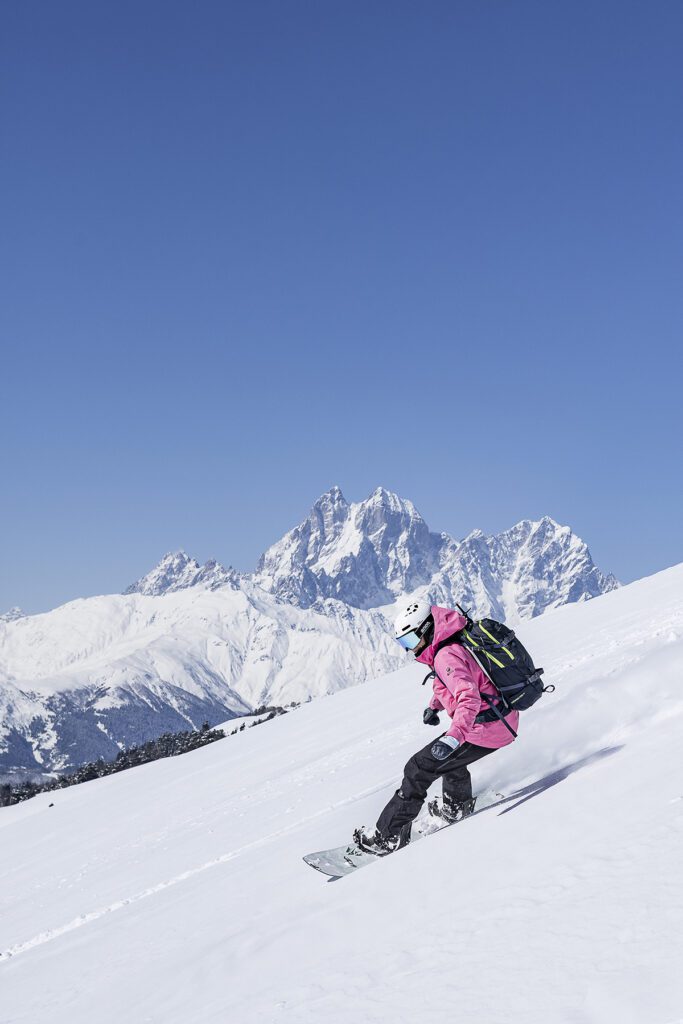
Tbilisi (TBS) – The main international hub. From Tbilisi to Mestia, plan eight to nine hours by road in winter. A 4×4 with winter tires is wise. Private transfers are common; self-drive is doable for confident winter drivers.
Kutaisi (KUT) – A growing low-cost gateway with direct flights from multiple European cities. From Kutaisi, you can route via Zugdidi and continue up to Mestia (roughly four hours from Zugdidi in winter conditions).
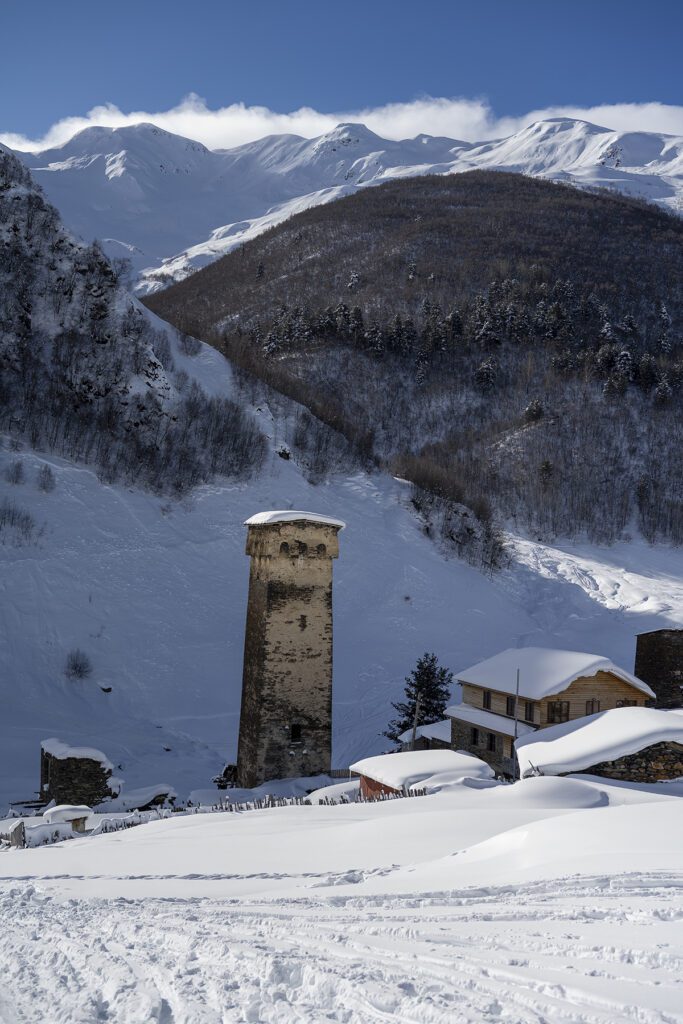
The FIS Freeride World Tour added Georgia in 2024 and returned in 2025 for stop four of the season, awarding key points before the Cut. After weather and safety work on another venue, organizers confirmed a reschedule and went back to Kakhiani for the showdown.
Snowboard Men: Cody Bramwell (GBR) took the win with a clean, high-scoring line.
Snowboard Women: Noémie Equy (FRA) extended her lead with a fluid run and a 360.
Georgia’s second straight FWT stop cemented Tetnuldi as a big-mountain stage with serious terrain and variable conditions, exactly the mix that’s building the region’s freeride reputation.
One of snowboarding’s most iconic rail jams filled a void the Finnish
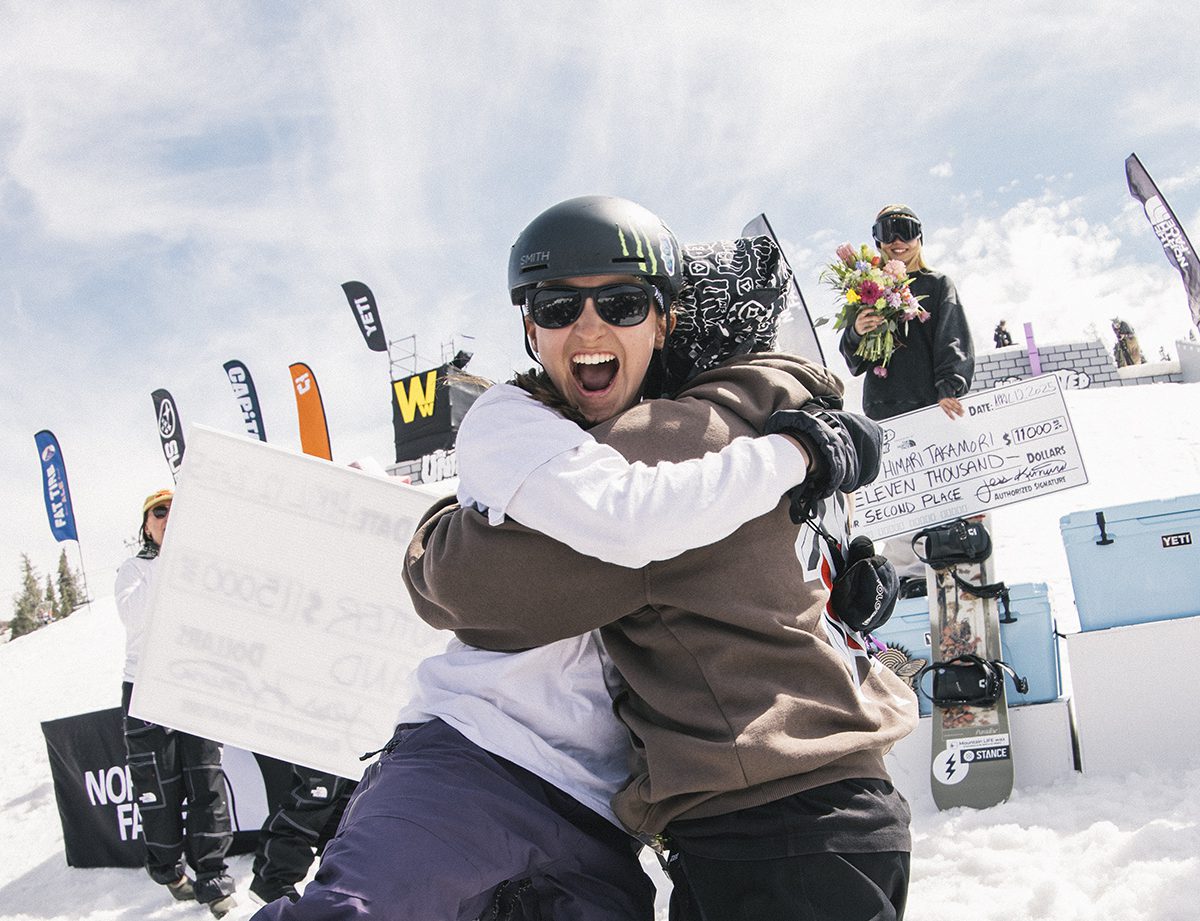
INTERVIEW: MARY T. WALSH PHOTOS: ASHLEY ROSEMEYER The first day of the 2024
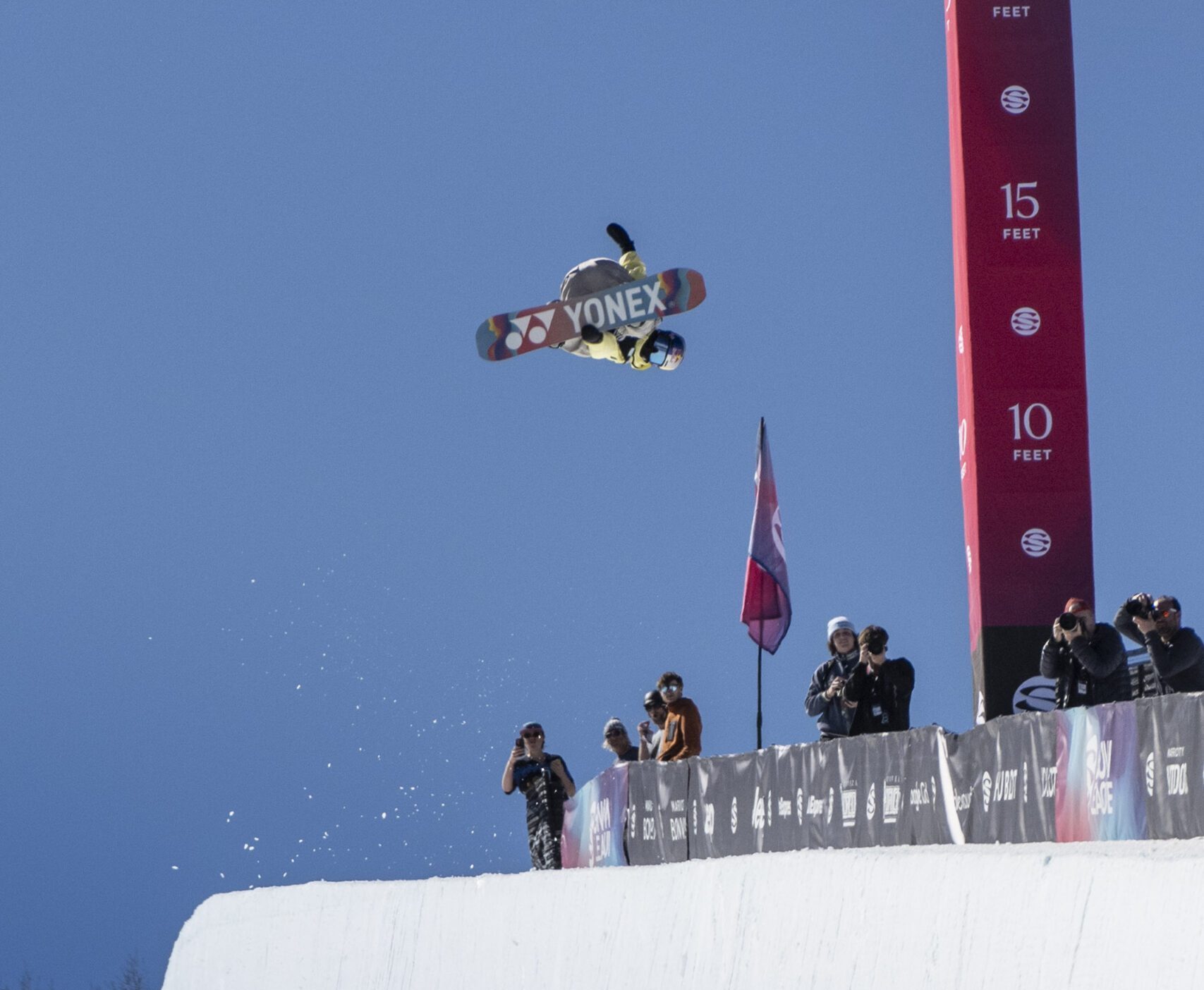
By the time Snow League wrapped in Aspen, the results were clear: